
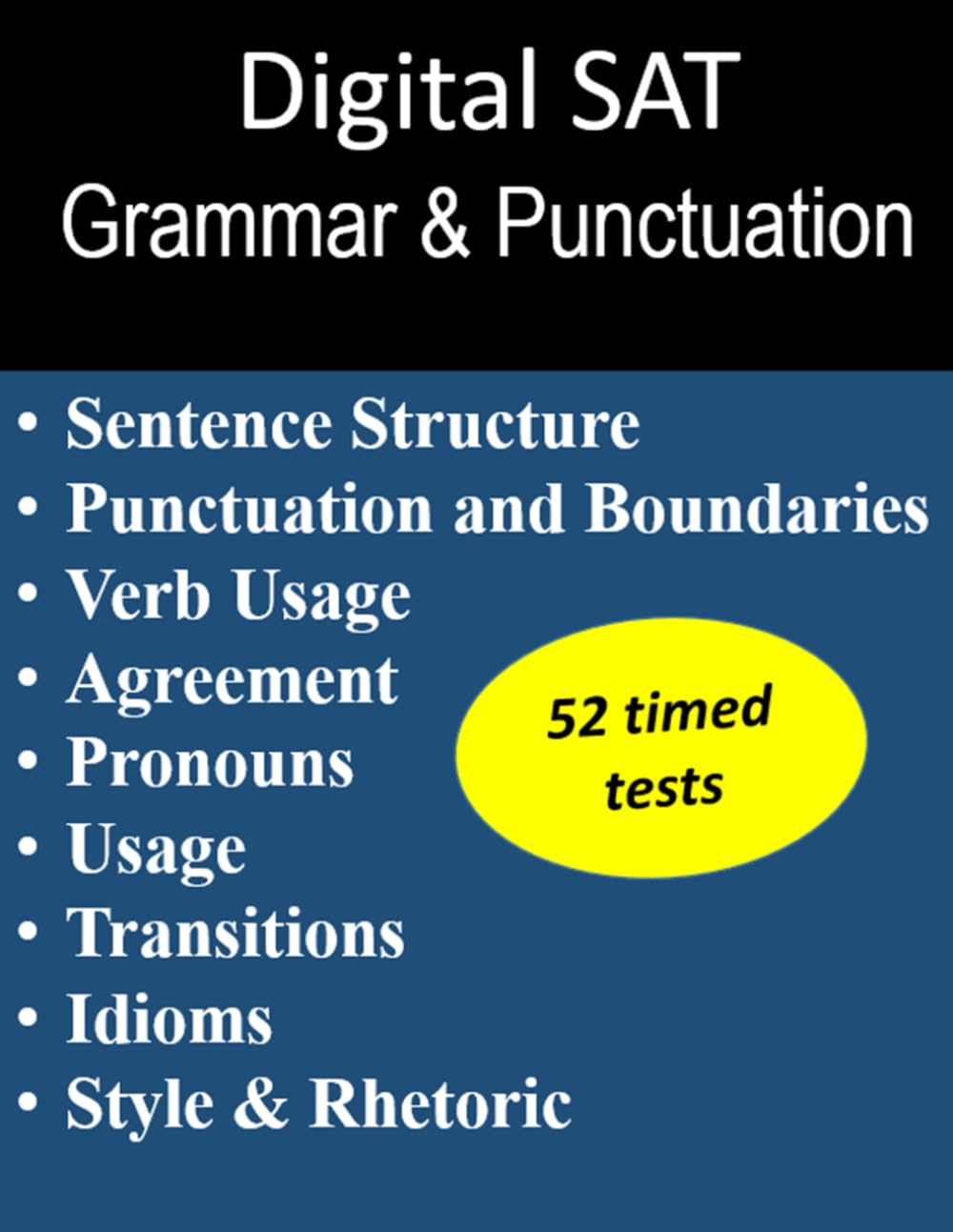
Digital SAT Grammar & Punctuation
Product details
| Management number | 236969922 | Release Date | 2026/07/10 | List Price | $7.67 | Model Number | 236969922 | ||
|---|---|---|---|---|---|---|---|---|---|
| Category | |||||||||
Welcome to Digital SAT - Grammar and Punctuation, a comprehensive resource designed to sharpen your grammar and punctuation skills in preparation for the Digital SAT.This book aims to help you master the essential rules of grammar and punctuation by providing practical exercises for mastering the concepts commonly tested on the exam.Why Grammar and Punctuation Matter for the Digital SATGrammar and punctuation are critical components of the Digital SAT, significantly impacting your performance in the Writing and Language section.Unlike previous versions of the SAT, the Digital SAT focuses on how well you can apply grammar and punctuation rules in real-world contexts, emphasizing clarity and accuracy in communication. Mastering these skills not only prepares you for the test but also enhances your overall writing abilities.Purpose of This BookThis book provides rigorous practice through targeted exercises designed to mirror the format and difficulty of the Digital SAT. The following concepts are tested;Sentence StructureSubject-Verb Agreement: Ensuring that subjects and verbs agree in number (singular or plural).Sentence Fragments and Run-ons: Identifying and correcting incomplete sentences and run-on sentences.Parallelism: Using the same grammatical structure in lists and comparisons.Modifier Placement: Correctly placing descriptive words or phrases to avoid ambiguity or confusion.Punctuation and BoundariesComma Usage: Proper use of commas in lists, after introductory elements, and to separate clauses.Semicolons and Colons: Correct usage to connect independent clauses and to introduce lists or explanations.Apostrophes: Correct use in contractions and to show possession.Quotation Marks: Proper use with direct quotes and titles of short works.Verb UsageVerb Tense: Consistency in verb tenses and correct usage of various tenses.Verb Forms: Correct forms of verbs, including irregular verbs.Active vs. Passive Voice: Preference for active voice over passive voice where appropriate.PronounsPronoun Case: Correct use of subjective, objective, and possessive cases.Ambiguous Pronouns: Avoiding pronouns that do not clearly refer to a specific noun.AgreementNoun-Number Agreement: Ensuring that nouns agree in number with other words in the sentence.Pronoun Consistency: Ensuring consistency in pronoun usage within a sentence or passage.UsageWord Choice: Correct usage of commonly confused words (e.g., their/there/they’re, affect/effect).Idiomatic Expressions: Proper usage of idiomatic phrases and prepositions.Style and Rhetoric Conciseness: Eliminating wordiness and redundancy.Tone and Style: Ensuring that the tone and style are consistent and appropriate for the context.TransitionsAddition: moreover, furthermore, in additionContrast: however, on the other hand, neverthelessCause and Effect: therefore, as a result, consequentlyExample: for example, for instance, namelyConclusion: in conclusion, ultimately, in summaryIdiomsContextual Understanding: Idioms help test comprehension of phrases in context.Avoid Literal Misinterpretation: Knowing idioms prevents confusing literal and figurative meanings.Language Fluency: Idioms are key to demonstrating natural language use. Read more
| ASIN | B0DHGP3DZY |
|---|---|
| ISBN13 | 979-8339575351 |
| Language | English |
| Publisher | Independently published |
| Dimensions | 8.5 x 0.28 x 11 inches |
| Item Weight | 13.4 ounces |
| Print length | 122 pages |
| Publication date | September 17, 2024 |
Bestseller ranking
SAT


Customers who viewed this product also viewed
Active Hoodies


Correction of product information
If you notice any omissions or errors in the product information on this page, please use the correction request form below.
Correction Request Form